Your cart
30-Day Satisfaction Guarantee
If you've spent any time browsing kratom vendors, you've probably noticed the names pile up fast. Maeng Da, Bali, Borneo, Red Vein, White. The terminology can feel overwhelming, especially when...
If you’ve spent any time browsing kratom vendors, you’ve probably noticed the names pile up fast. Maeng Da, Bali, Borneo, Red Vein, White. The terminology can feel overwhelming, especially when you’re just trying to figure out what to order. There’s just random words and colors being thrown at you.
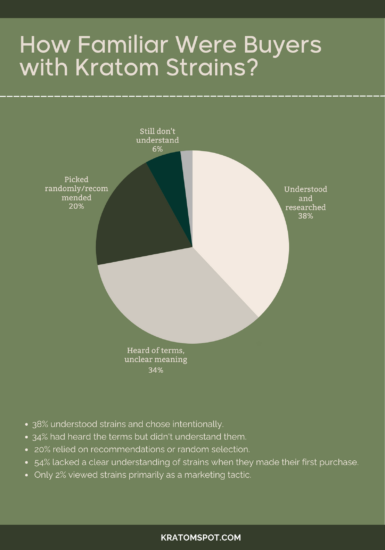
You’re not alone. According to a 2026 Kratom Spot survey, only 38% of buyers had a clear understanding of kratom strains when they made their first purchase.
Kratom (Mitragyna speciosa) is a tropical tree native to Southeast Asia, and the term “strain” refers to a combination of two things: the color of the leaf vein at harvest time, and the geographic region where the plant was grown.
Vein color is the more meaningful of the two variables. The veins running through a kratom leaf change color as the plant matures. From white in early growth, to green in mid-maturity, to red when fully mature. Farmers harvest leaves at specific stages to capture different alkaloid concentrations, and those differences carry through to the final powder or capsule. Which, in turn, affects the user experience.
Geography adds a second layer. Soil composition, humidity, altitude, and rainfall patterns in places like Borneo, Sumatra, or Bali all influence how the kratom plant develops. Two red vein strains grown in different regions can have meaningfully different alkaloid profiles even if they’re harvested at the same stage of maturity.
Then there are names like “Maeng Da” or “Bentuangie.” These aren’t regions, they’re processing or genetic designations that have become industry shorthand. More on those later.
The bottom line: when you see a strain listed as “Red Bali” or “Green Borneo,” you’re getting two pieces of information. The harvest stage (vein color) and the origin (region). Understanding both is the foundation of making an informed selection.
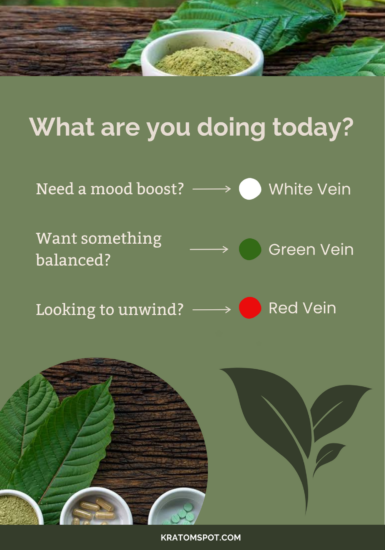
Red vein kratom is harvested from fully mature leaves, the stage at which mitragynine and 7-hydroxymitragynine concentrations tend to peak. It’s consistently the most popular vein color among experienced buyers, and survey data from Kratom Spot backs that up. 45% of respondents preferred red vein strains for evening use, the highest evening preference of any color.
Red vein strains are typically associated with a calming character profile, which makes them a go-to for buyers looking to wind down. The drying and curing process also plays a role in shaping the final product. Longer fermentation (as in Bentuangie) tends to produce a more mellow alkaloid profile than standard red processing.
Popular red vein varieties:
Red Bali is one of the most widely available strains on the market and a common starting point for new buyers. It’s grown primarily in Bali and Borneo and is known for consistency across batches, an important factor when you’re still calibrating your preferences.
Red Borneo comes from the island of Borneo (shared by Indonesia, Malaysia, and Brunei) and is grown in nutrient-rich river basin soil. It tends to carry a smooth, calming profile and is one of the more predictable red veins for repeat buyers.
Red Maeng Da is a grafted or selectively cultivated variety. “Maeng Da” translates roughly to “pimp grade” in Thai, a colloquial designation for high-potency material. Red Maeng Da is one of the stronger red veins available and is popular with experienced users who want a more pronounced calming experience.
Red Thai originates from Thailand, though much of what’s sold as Red Thai today is actually grown in Indonesia due to historical legal restrictions on kratom cultivation in Thailand. It carries a milder profile compared to Maeng Da variants.
Bentuangie is a fermented red vein variety, typically from Indonesia. The extended fermentation process converts alkaloids into different compounds, resulting in a distinctly softer, more rounded character that many buyers describe as the most calming strain in the red category.
White vein kratom is harvested early, before the leaf has fully matured. At this stage, alkaloid content skews differently than red. Mitragynine is present but 7-hydroxymitragynine levels are lower. The result is a strain category that’s often described as mood-boosting and mentally clarifying rather than calming.
In the Kratom Spot survey, white vein ranked as the preferred morning strain for 38% of respondents — the most time-specific preference pattern of any color. That tracks with how most experienced buyers use it: white vein tends to be a morning or early afternoon choice rather than an evening one.
Popular white vein varieties:
White Maeng Da is among the most widely searched kratom strains online, and for good reason. It delivers one of the more pronounced mood-boosting profiles in the white category. It’s a cultivated/grafted variety rather than a strict regional origin, so quality can vary significantly by vendor.
White Borneo is grown in the rainforest regions of Borneo and is considered one of the cleaner white veins available. It has a reputation for being well-balanced within the white category. Mood-boosting without being harsh or overwhelming for newer buyers.
White Thai carries a strong, clear-headed character and is popular with buyers who want a pronounced mood lift. Like Red Thai, a significant portion of White Thai is now grown in Indonesia despite the name.
White Horn gets its name from the distinctive spiked edges of the kratom leaves it’s derived from, which are found primarily in Borneo. Horn leaves are relatively rare, which limits supply and makes White Horn one of the more premium white vein options.
White Sumatra comes from the island of Sumatra in Indonesia, one of the oldest kratom-producing regions in the world. It tends to carry a longer-lasting profile compared to other whites, which some buyers prefer for sustained morning use.
Green vein kratom occupies the middle of the maturity spectrum and is harvested after white but before red. Alkaloid content reflects that middle ground: more developed than white vein, less concentrated than red. The result is a strain category that’s widely considered the most versatile of the three.
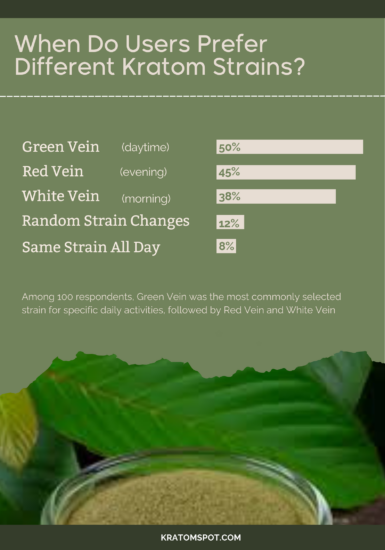
Survey data puts green vein at the top for daytime use, with 50% of respondents selecting it as their preferred strain for specific daytime activities that is higher than both red (45% evening) and white (38% morning). It’s the only vein color that doesn’t cluster around a single time of day, which speaks to its flexibility.
Popular green vein varieties:
Green Maeng Da is one of the best-selling strains in the entire kratom market. It delivers a balanced alkaloid profile that’s mood-boosting without being overstimulating and mildly calming without being sedating. That makes it an ideal starting point for first-time buyers who aren’t sure what they’re looking for yet.
Green Borneo is grown in the interior rainforests of Borneo and is known for a smooth, consistent character. It’s a reliable everyday strain and one of the more forgiving greens in terms of batch-to-batch variation.
Green Bali is one of the more affordable green veins and is widely available. It’s slightly earthier in flavor than other greens and carries a mild, balanced profile that works well for mid-day use.
Green Malay (also called “Super Green Malay”) originates from Malaysia and has a reputation for one of the longer-lasting profiles in the green category. Experienced buyers often gravitate toward it when they want sustained, balanced character throughout a long day.
Green Vietnam is grown along the Mekong River in Vietnam and is a newer addition to the mainstream kratom market. It’s known for a uniquely smooth, clean profile and is gaining a following among buyers who’ve worked their way through the more common greens.
In our 2026 survey, we found that people actually do have preferences for when they use specific kratom strains.
Now that we’ve covered vein colors, it’s worth spending more time on what regional and designational names actually mean, because the industry uses them inconsistently, and understanding the distinction can save you from confusion when shopping.
True origin strains are named after the geographic region where the plant is grown. Borneo, Sumatra, Bali, Vietnam, and Thailand all fall into this category. The growing environment (soil, altitude, rainfall) does create measurable differences in alkaloid expression, which is why these distinctions matter.
Maeng Da is not a region. It’s a cultivated or grafted variety originally developed in Thailand for higher potency. Today it’s grown across multiple regions (primarily Indonesia), and what makes it “Maeng Da” is more about genetic selection and processing standards than geography. A reputable vendor should be able to tell you where their Maeng Da is actually sourced.
Bali kratom is somewhat of a misnomer. Most Bali kratom is actually grown in Borneo or Sumatra and shipped through Bali’s ports. The name stuck as a marketing designation rather than a strict origin label. That said, it has developed its own identity: Bali strains tend to be smooth, widely available, and affordable.
Bentuangie is a processing designation, not a place. It refers to a specific fermentation method applied to red vein leaves. The process converts certain alkaloids into different compounds, producing a distinctly different character profile than traditionally dried red vein material.
Horn and Elephant strains are named after leaf morphology. Horn leaves have jagged, spiked edges; Elephant leaves are large and floppy. Both are found primarily in Borneo. Whether leaf shape meaningfully predicts alkaloid content is debated, but these varieties do have established reputations among experienced buyers.
A note on “Super” designations: Terms like “Super Green Malay” or “Super White Borneo” typically refer to products made from only the largest, oldest leaves, which tend to have higher alkaloid concentrations. It’s a loose designation with no formal standard, so batch testing is more reliable than the label alone.
With dozens of strains available, the selection process can feel paralyzing, especially for new buyers. The good news: most decisions come down to three variables.
Once you’ve narrowed to a vein color, regional names become a secondary filter. Borneo and Malay greens tend to last longer; Bali and Sumatra reds tend to be smoother; Maeng Da varieties across all colors tend to be more potent. Treat those generalizations as a starting hypothesis, not a guarantee.
Now, here’s a real eye-opener. How much of this actually matters? In our survey, we asked respondents to let us know how accurate they believe strain descriptions are.
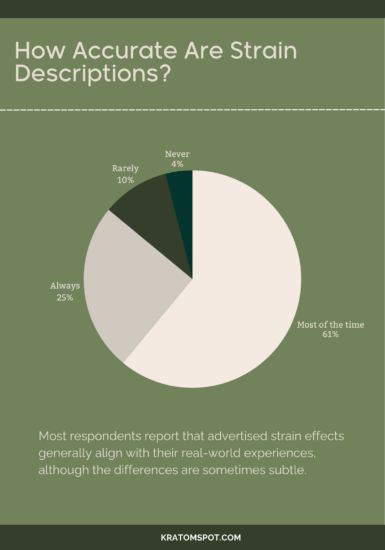
86% of kratom users believe that strain descriptions are accurate most or all of the time.
The strain name on a product label tells you a lot, but it doesn’t tell you everything. Potency and quality are downstream of several factors that the label alone won’t reveal.
Alkaloid content is the primary driver of potency. Mitragynine is the dominant alkaloid in kratom, typically comprising 1-2% of dried leaf weight in standard commercial material, with 7-hydroxymitragynine present in trace amounts. Higher-quality material from reputable vendors (like Kratom Spot) will have third-party Certificates of Analysis (CoAs) confirming actual alkaloid percentages, which is the only reliable way to verify potency claims.
Harvest timing matters more than most buyers realize. Even within a single vein color, leaves harvested at slightly different stages will have different alkaloid ratios. This is part of why batch consistency is one of the most important quality markers for any vendor.
The drying and processing method further shapes the final profile. Traditional sun-drying, indoor drying, UV exposure, and fermentation (as in Bentuangie) all produce different results from the same raw leaf material. A vendor that can speak to their processing method is generally more trustworthy than one that can’t.
Freshness degrades kratom’s alkaloid content over time. Mitragynine oxidizes when exposed to light, air, and heat. Which is why storage practices and packaging quality matter. Look for products with sealed, opaque packaging and check for production/testing dates where available.
How accurate are vendor strain descriptions? According to the Kratom Spot survey, 61% of users say vendor descriptions align with their experience most of the time, and 25% say they always align. Only 14% reported rarely or never finding descriptions accurate. That’s a reasonably good signal-to-noise ratio, but it also underscores the value of buying from vendors with transparent testing practices. Descriptions are more reliable when backed by lab data.
When evaluating a new vendor, the minimum quality signals to look for are: current third-party CoAs (ideally per-lot, not just per-strain), clear sourcing information, and GMP-compliant or AKA-certified manufacturing practices.
There’s no official count, and the number expands regularly as vendors introduce new regional varieties and processing methods. Most experienced buyers work with a core set of 10-15 well-established strains (across the three main vein colors) rather than chasing every new label.
No. There’s no regulatory body governing kratom strain nomenclature, which means naming conventions vary by vendor. “Red Bali” from one vendor may not be identical to “Red Bali” from another. Third-party CoAs are the most reliable way to compare products across vendors.
The strain itself is the same. Capsules are simply pre-measured powder in a gelatin or vegetable cellulose shell. Capsules offer convenience and more consistent dosing; powder offers more flexibility and faster preparation. The underlying alkaloid content should be equivalent for the same product.
Yellow vein is not a true vein color the way white, green, and red are. It’s a processing designation. Most yellow kratom is white or green vein material that’s been dried for an extended period or blended, which alters the alkaloid profile and the color of the finished powder.
Not always. As noted above, most “Bali” kratom is grown in Borneo or Sumatra. Much of what’s sold as “Thai” kratom is now grown in Indonesia. What matters more than the label’s geographic accuracy is whether the vendor can provide documentation of actual sourcing, processing standards, and lab testing.
Store kratom in a sealed, airtight container away from direct light and heat. A cool, dark pantry or cabinet works well. Avoid storing near windows or in areas with temperature fluctuations. Properly stored kratom powder can maintain alkaloid integrity for 1-3 months; longer storage should be vacuum-sealed and frozen.
Lorem ipsum dolor sit amet, consectetur adipiscing elit. Ut elit tellus, luctus nec ullamcorper mattis, pulvinar dapibus leo.
This article is intended for informational purposes only and does not constitute medical advice. Kratom is not approved by the FDA to diagnose, treat, cure, or prevent any disease or health condition. Always consult a qualified healthcare professional before use.